Turn any website into a book your agents can read.
okf-kit crawls a site into a portable Open Knowledge Format bundle — a folder of plain markdown your agents, tools, and teammates can all read. No LLM. No browser. No cloud. Install in seconds; build your first book in one command.
Knowledge that installs in seconds, not a cloud account.
Most "AI knowledge" tools want a model key, a vector database, and a service to call. okf-kit wants a URL.
No LLM required
The entire build path — crawl, structure, validate — runs with zero API keys and zero model calls. An LLM is optional, only if you want chat or enrichment.
Lightweight to a fault
No headless browser, no heavyweight ML stack. pip install okf-kit and you're crawling in seconds.
Portable & lock-in free
A bundle is a folder of markdown + YAML. Commit it, diff it, zip it. Readable by humans, agents, Obsidian, MkDocs — anything.
Built to be consumed
Chat with any provider or fully offline via Ollama, serve to Claude Code & Cursor over MCP, or explore it visually.
Five commands, one folder of knowledge.
Build it, keep it fresh, talk to it, see it, and publish it for others — each is a single command.
Build
okf build <url>Crawl a site into a conformant OKF bundle. No key needed.
Sync
okf sync my-bookRe-crawl; only changed pages update. Tiny git diffs.
Chat
okf chat my-bookAsk questions — OpenAI, Ollama, or zero-key retrieval.
Visualize
okf visualize my-bookA readable explorer of every concept & its links.
Publish
okf zip my-bookShare it, or add it to the community registry.
Community bundles, ready to pull.
Every book in the registry, loaded live from GitHub. Add yours and it appears here automatically — no site edit required.
Prefer a window to a terminal? Get the app.
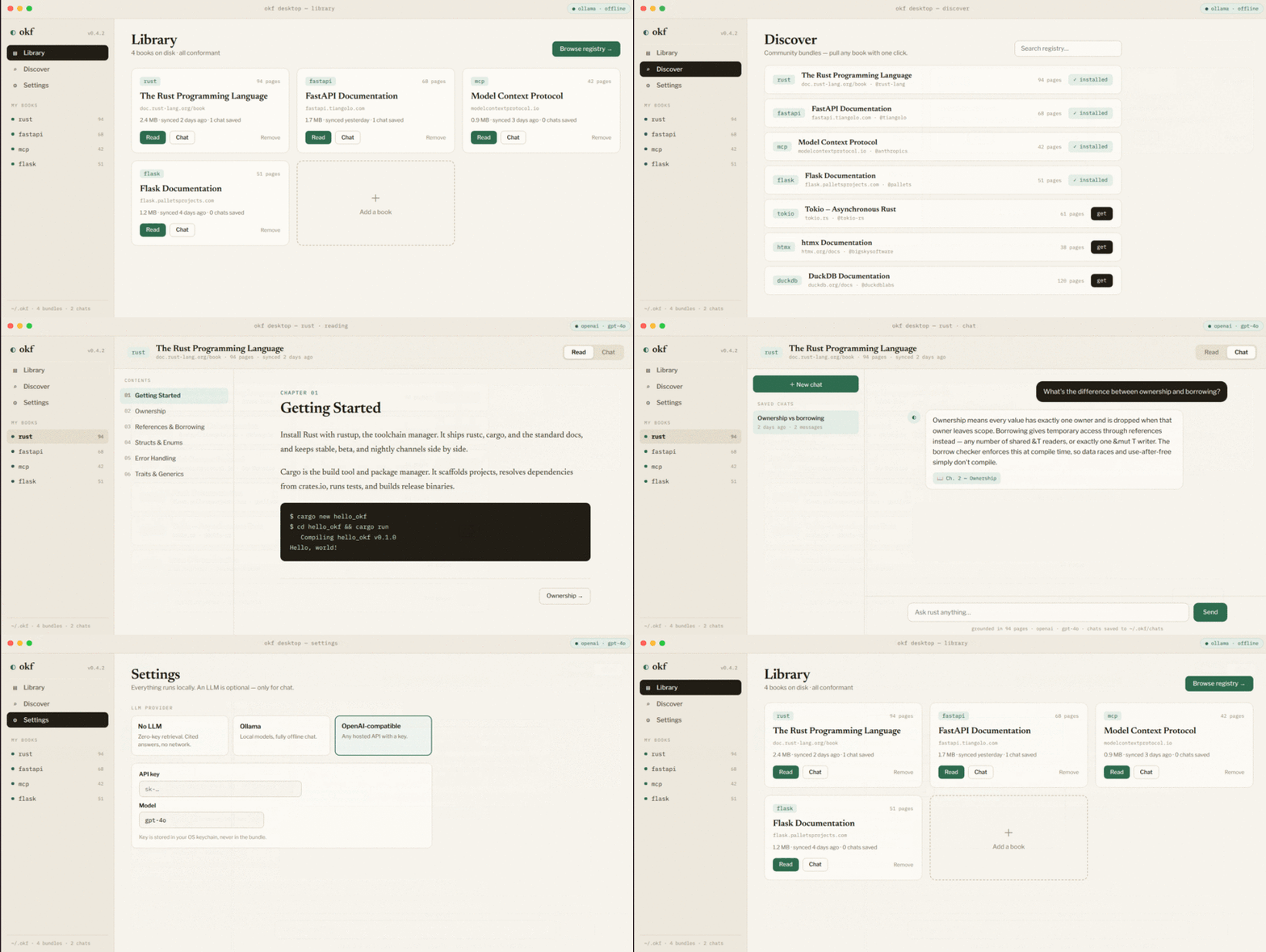
okf desktop is a free, open-source app built on okf-kit — browse the registry, install books, read them like a book, and chat with cited answers, fully offline. Download and run; no Python or install needed.
Free & open source (AGPL-3.0). Builds are unsigned. macOS: if it says "damaged", clear the download flag — xattr -dr com.apple.quarantine ~/Downloads/okf-desktop.app — then open it (or System Settings → Privacy & Security → Open Anyway). Windows: SmartScreen → More info → Run anyway. Linux: needs system GTK 3 + WebKit2GTK.
Same format. Different mission.
Open Knowledge Format is a Google-authored spec. okf-kit is an independent, lightweight implementation of it — and the two interoperate.
| okf-kit | Google reference agent | |
|---|---|---|
| Source | Any website | BigQuery / Dataplex catalog |
| Producer | Deterministic crawler — no key | LLM agent (Gemini + GCP auth) |
| Footprint | pip install, seconds, no browser | Cloud SDKs, google-adk, BigQuery |
| Consume | chat (offline too), MCP, explorer, registry | Cytoscape viewer |
| Sync | Incremental re-crawl | — |
| License | Apache-2.0 | Apache-2.0 |
Frequently asked
What is okf-kit?
okf-kit is a lightweight, open-source Python library and CLI that turns any website into a portable Open Knowledge Format (OKF) bundle — a folder of plain markdown files that AI agents, tools, and people can all read. It runs a deterministic crawler (no LLM required), then lets you chat with the result offline, serve it to coding agents over MCP, and keep it in sync as the site changes.
Does okf-kit require an LLM or API key?
No. The entire build path — crawl, structure, validate — runs with zero API keys and zero model calls. An LLM is optional: you only need one for synthesized okf chat answers (use Ollama for fully offline), or the optional --enrich step. With no model configured at all, okf chat still answers from a zero-key retrieval fallback, with citations.
What is the Open Knowledge Format (OKF)?
OKF is an open, vendor-neutral specification for representing knowledge as plain markdown files with a small set of YAML frontmatter fields (type, title, description, resource, tags, timestamp). It was introduced by Google as part of its Knowledge Catalog work. okf-kit is an independent, unofficial implementation of the spec — and it interoperates: okf-kit validates and renders Google's own reference bundles unchanged.
How is okf-kit different from Google's OKF tools?
Google's reference implementation targets BigQuery / data-catalog metadata using an LLM enrichment agent. okf-kit targets any website with a deterministic crawler that needs no LLM, no cloud, and no API key — and adds incremental sync, offline chat, an MCP server for coding agents, and a community registry. Same format, complementary mission; the two interoperate.
Can I use okf-kit with Claude Code, Cursor, or other MCP clients?
Yes. okf serve-mcp <bundle> runs a stdio MCP server exposing list_bundles, list_directory, read_concept, and search_bundle, so Claude Code, Cursor, or any MCP client can read a project's up-to-date docs locally. There's also a Docker image for running it as a container.
Does okf-kit work offline?
Yes. Building a bundle only needs network access to crawl the site once; after that it's all local files. okf chat works fully offline with a local model via Ollama, and even with no model configured it answers from a zero-key retrieval fallback.
What websites can okf-kit crawl?
Any static or server-rendered HTML site — documentation sites, wikis, blogs. It respects robots.txt and scopes the crawl to the seed's path by default. JavaScript-rendered single-page apps need the optional [js] extra, which uses a real browser. Extraction quality varies by site.
Is okf-kit free and open source?
Yes — okf-kit is free and open source under the Apache-2.0 license. Install it with pip install okf-kit. The source is on GitHub, and there's a community registry of ready-made bundles you can pull with okf get <name>.
Build your first book in the next two minutes.
Point it at any docs site. No account, no key, no waiting on a model. Then publish it to the registry so the next person can just okf get it.
$ pip install okf-kit
$ okf build https://your-docs.example.com -o my-book
✓ 48 pages → my-book  (CONFORMANT)
$ okf chat my-book            # or --provider ollama, fully offline